
There’s no business like show business
like no business I know
Everything about it is appealing,
everything that traffic will allow
Nowhere could you get that happy feeling
when you are stealing that extra bow
Irving Berlin – 1954
Over the life of a customer, you should expect to get five times as much revenue in the years after the initial sale compared to the value of that first sale. This is known as Customer Lifetime Value (CLV). It varies by industry but the old truth remains, “Customers are hard to get and easy to lose.”
That’s why Old Business is big business.
There is a tendency in marketing and in sales to chase the new opportunities, markets, and channels. Unless you devote some energy to your existing customer base, you are will likely find the profit that fuels your growth plans becomes harder to sustain.
That’s why we at Stars.Systems develop exciting marketing programs to bring in new customers AND preserve your existing ones.
Any marketing be it exclusively new customer acquisition focussed or exclusively customer retention focussed, will have benefit in the other segment of your customers. It is a clearly accepted fact that if you stop marketing to your base you will lose them. So make them part of your new acquisition marketing.
This is the customer lifecycle curve: it has three elements:
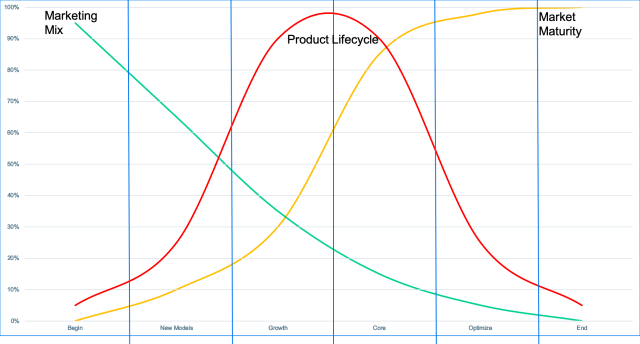
The red line: the Product Lifecycle, start with no market, grow the market, competitors enter the market, market saturation, market decline, market end of life
The green line: the Marketing Mix, representing both the diversity of marketing channels and the investment required to sustain the expected market penetration
The yellow line: the Marker Maturity, really the saturation of the market with the product (below the line) and the market opportunity (above the line).
The Old Business is any business after acquisition (closing the sale) but, in practical terms, for most modern businesses it is after the customer has accepted the product and is happy with it. We make product returns very easy these days so a sale isn’t guaranteed even though the customer paid for the product.
That’s why, at Stars.Systems, we adopt a model that flattens out the right side of the Product lifecycle so that the inevitable decline in the install base is the shallowest of glide slopes.
We do this through our Install Base Marketing program that includes:
- Regular updates with value-content that enables the customer to get more out of their investment in your product
- Special events (online and in person) where product users can come together and share their best practices that maximize the value of the product
- Personal briefings with the product creators 1-on-1 (online and in person) that makes the customer feel special
- Innovations in add-ons and upgrades with special “member only” pricing
In short, we do everything we can to extend the life of the product and the commitment of the customer but we do it with the lowest cost possible.
Once the customer is gone they are not coming back. A program like this can cost as little as 2.5% of the monthly income from your customers and it can reduce your attrition rate by 90%.
Assume you have 100 customers paying $100 a month for your service. That’s $120,000 per year. If your annual attrition rate is 10%, that is $108,000 in year+1, $97,200 in year+2, $87,480 in year+3.
But, if you can slow the attrition to say, 5%, you will end up with $114,000, $108,300, $102,890 over those same 3 years and be $32,519 better off. Take off the cost of the program at 2.5% of revenue and you’re still over $25,000 better off.
 Stars.Systems